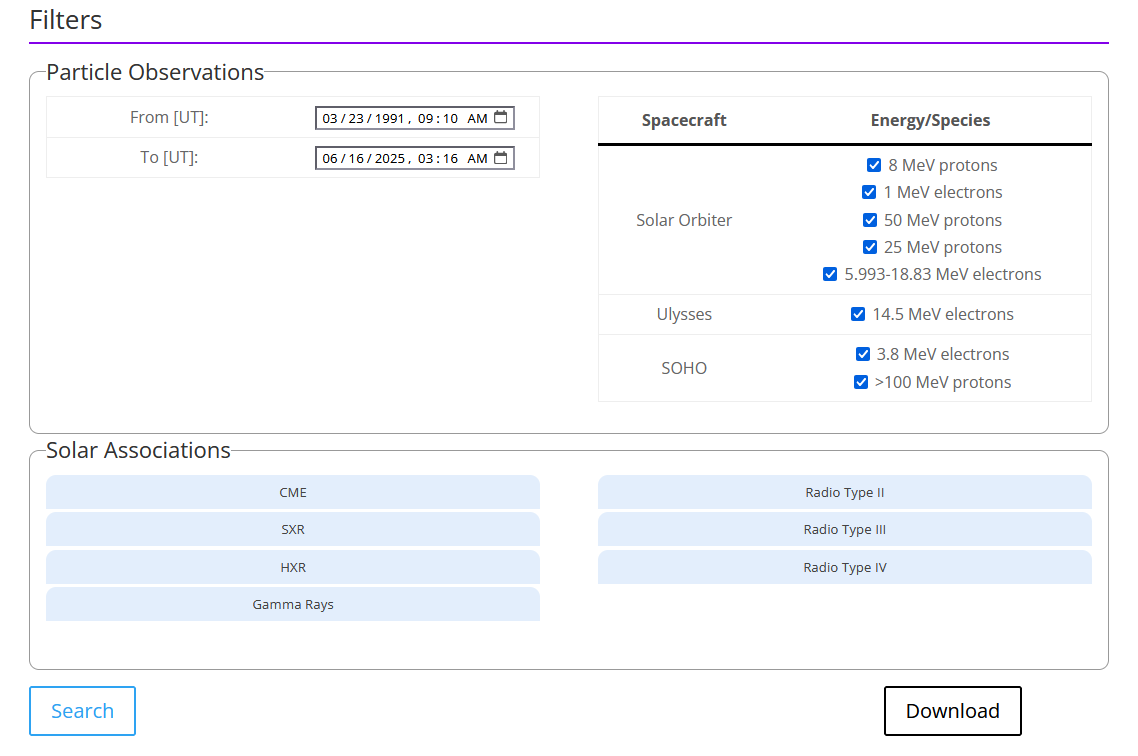
The SPEARHEAD Horizon Europe project is pleased to announce that all major catalogues developed within the project are now publicly accessible through the new Catalogues & Data section of the SPEARHEAD website. The collection brings together unique datasets covering Solar Energetic Particles (SEPs), Solar Energetic Electrons (SEEs), and Forbush decreases, providing researchers with new opportunities to investigate particle acceleration, transport, and space weather phenomena throughout the heliosphere.
The catalogue collection spans multiple spacecraft and more than three decades of observations. Among the newly available resources are:
- A catalogue of 172 >100 MeV solar proton events observed by SOHO/ERNE between 1996 and 2024, including detailed associations with solar flares, CMEs, radio bursts, gamma-ray emission, and Ground Level Enhancements (GLEs).
- The new Solar Orbiter/HET SEP Catalogue, containing large SEP events observed during the first five years of the Solar Orbiter mission, including electrons, protons, solar source associations, and particle release analyses.
- A catalogue of 135 solar energetic electron events observed by SOHO/EPHIN between 1997 and 2017.
- A catalogue of high-energy solar energetic electron events observed by Ulysses/KET, providing rare observations across a wide range of heliographic latitudes.
- The SPEARHEAD Forbush Decrease Catalogue (FDcat), compiling flux-rope-related Forbush decreases observed by Helios, Solar Orbiter, Ulysses, SOHO, the South Pole neutron monitor, and MSL/RAD at Mars.
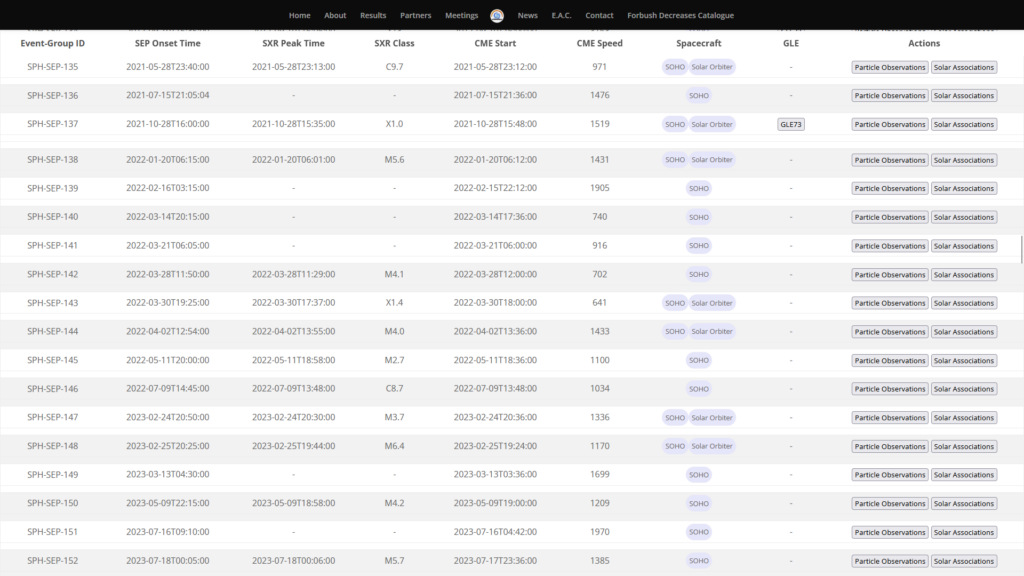
Together, these catalogues form one of the most comprehensive collections of high-energy particle datasets produced within a European heliophysics project. By combining observations from multiple spacecraft, energy ranges, and heliospheric locations, they support investigations of SEP acceleration, particle transport, CME evolution, and space weather impacts across the inner heliosphere.
All catalogues are openly available through the SPEARHEAD website and the project’s Zenodo community, reflecting the consortium’s commitment to open science and long-term community impact. Researchers, students, and stakeholders are invited to explore and use these resources in future scientific studies and applications.