

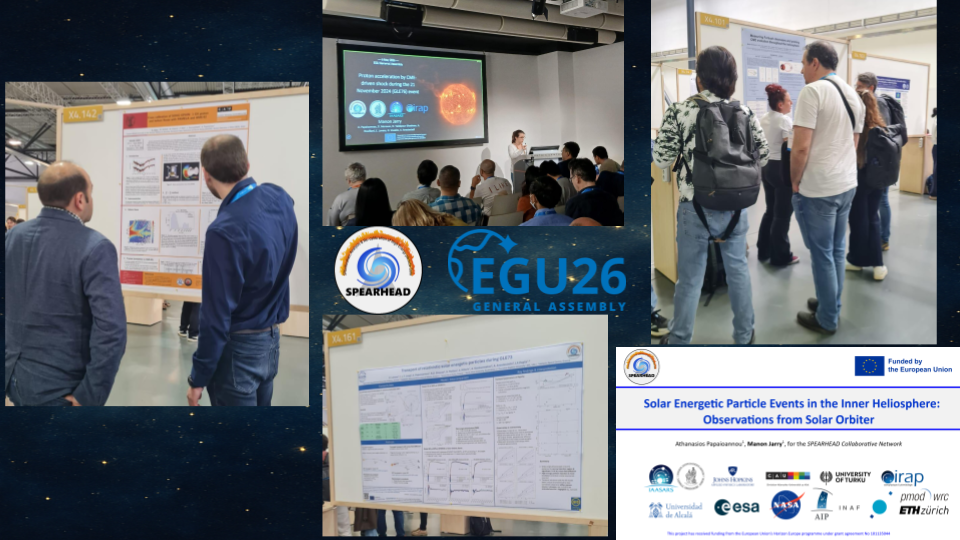
The SPEARHEAD Horizon Europe project participated actively in the EGU General Assembly 2026, presenting a broad range of new scientific results related to Solar Energetic Particles (SEPs), Forbush decreases (FDs), CME-driven shocks, particle transport, and heliospheric modelling. Through oral presentations and posters, SPEARHEAD researchers showcased recent advances based on multi-spacecraft observations, simulations, catalogues, and open-source analysis tools.
One major highlight was the presentation of a new SEP catalogue based on observations from Solar Orbiter during Solar Cycle 25. The catalogue currently includes 174 SEP events detected between 2020 and 2025 and is accompanied by newly developed open-source tools supporting the identification and analysis of energetic particle events and their solar origins.
Another important contribution focused on the remarkable 21 November 2024 Ground Level Enhancement event (GLE76). Although the eruption originated on the far side of the Sun, high-energy protons (>100 MeV) were observed near Earth. By combining observations from STEREO, Solar Orbiter, and SOHO with advanced magnetohydrodynamic simulations, SPEARHEAD researchers investigated how CME-driven shocks accelerate energetic particles and how these particles propagate through the heliosphere.
SPEARHEAD contributions at EGU2026 also explored energetic particle transport and magnetic connectivity in the inner heliosphere for the relativistic particle event GLE73, highlighting how the evolving geometry of shocks and magnetic field lines affects SEP observations across multiple spacecraft. These studies provide new insights into the mechanisms governing particle acceleration and transport — key processes for understanding space weather and improving forecasting capabilities.
Additionally, a recently developed analytical model describing CME-related Forbush decreases using an expansion-diffusion approach was presented as a new method to analyse CME evolution throughout the heliosphere. Applying this model, SPEARHEAD researchers catalogued and analysed ICMEs and associated FDs using measurements from Helios, Ulysses, SOHO, and Solar Orbiter, together with ground-based observations from the South Pole neutron monitor and MSL/RAD measurements at Mars.
The project’s presentations and posters attracted strong interest throughout the conference, generating lively discussions and numerous questions from researchers working in heliophysics and space weather science. This engagement highlighted the growing importance of coordinated observations, advanced modelling, and international collaboration for understanding the Sun–heliosphere system.
Through its participation in EGU2026, SPEARHEAD once again demonstrated its role in advancing high-energy particle research and strengthening Europe’s preparedness for future heliospheric and space weather challenges.